Round-up on three key issues and the core challenge for 2026
ISRAEL AND PALESTINE
Israel intensifies de facto annexation of West Bank
The latest commentary on Israel-Palestine by the International Crisis Group focuses on Israel’s increasingly brutal campaign of de facto annexation of the West Bank, despite President Donald Trump’s insistence that Israeli annexation of the West Bank is off the table.
Israeli actions include:
- The highest number of settler attacks on Palestinians since the UN started keeping track in 2006
- The machinery of settlement, continuing apace with thousands more settler homes approved and legislative actions begun to officially annex the West Bank
- Increasing economic suffocation of Palestinians, with 900 roadblocks inside the Occupied Palestinian Territory (OPT), a near-total ban on permits to work in Israel, and a clamp down on informal trade with Palestinians in Israel and the OPT
- Continued withholding from the Palestinian Authority (PA) of tax revenues Israel collects on its behalf, denying funds to the West Bank’s biggest employer and provider of social services
- Continued severe restrictions on the Palestinian banking system
Trump administration responds to Israeli killing of top Hamas leader in Gaza
Despite U.S. silence in the face of continued Israeli bombing of Gaza and restriction of vital humanitarian assistance, media reports suggest that the White House considered the killing by Israel of a top Hamas commander in Gaza recently as a dangerous violation of the ceasefire agreement, indicating to Netanyahu in a private message that:
If you want to ruin your reputation and show that you don’t abide by agreements be our guest, but we won’t allow you to ruin President Trump’s reputation after he brokered the deal in Gaza.
Israel is vulnerable to U.S. pressure, if only because Trump does not want his Gaza peace plan imperilled, which is exactly what Israel’s actions in both Gaza and the West Bank are doing.
No international stabilization force for Gaza without a negotiated disarmament deal
Many countries are willing to commit troops to help police Gaza and to help pay for rebuilding. But none will do so before a negotiated disarmament deal is in place – the Israeli army having failed to forcibly disarm Hamas in two years of brutal siege.
In the words of the Crisis Group:
The obvious Palestinian candidate to take Hamas’s guns is the PA in the West Bank….
Yet Israel’s policy of systematically withholding tax funds owed to the PA in the West Bank is rendering the PA toothless.
No international stabilization force for Gaza without a “clear political horizon”
Likewise, few of the countries that are otherwise willing to commit troops to Gaza are likely to do so in the absence of a clear path forward to the establishment of an independent, sovereign and viable Palestinian state.
Crisis Group calls for much “bolder action” by foreign governments
To have any real prospect of making an impact, foreign governments will have to be much bolder.
The Crisis Group calls on the EU to take key actions that do not require unanimous backing of member states, including:
- banning Israeli trade in goods and services emanating from settlements in the West Bank and
- restricting visa-free travel for certain Israeli decision-makers implicated in human rights or UN charter breaches.
Israel fails in its bid to block ongoing ICC Gaza war crimes investigation
In the midst of America’s ongoing assault on international law, including sanctioning and attempted financial crippling of the International Criminal Court, appeals judges of that court rejected Israeli efforts to overturn a lower court decision allowing the ICC prosecutor to investigate alleged crimes in Israel’s war on Gaza following the Hamas-led attack on southern Israel on October 7, 2023.
The decision upholds the continuation of the court’s Palestine investigation and the validity of its issuance of arrest warrants in November 2024 for Israeli Prime Minister Benjamin Netanyahu and former Defence Minister Yoav Gallant over alleged war crimes and crimes against humanity.
Whither Canada?
As with the EU, much bolder action is required from Canada in the face of egregious Israeli violations of the Gaza Ceasefire agreement and its accelerating campaign of de facto West Bank annexation.
In this regard, we refer to our blog post of 17 June 2025 and the comprehensive list of concrete actions that civil society called on the Government of Canada to undertake on an urgent basis.
The list included a call for Canada to forthwith recognize the State of Palestine. On 21 September 2025 Canada did just that, as we highlighted in our October 2025 blog post.
But most of the other calls to action remain unfulfilled, and they are now more urgent than ever if the Gaza Peace Plan is to have any chance at all.
We therefore reiterate our call on the Government of Canada to immediately withdraw from the free trade agreement between Canada and Israel, which is now in breach of fundamental international norms.
In light of the recent ruling of the Appeals Court of the International Criminal Court upholding the validity of the warrants issued against Prime Minister Netanyahu and former Defence Minister Gallant for alleged war crimes, we reiterate our call for Canada to impose sanctions on them as well as other Israeli leaders suspected of involvement in atrocity crimes in both Gaza and the West Bank, including Minister of Defence Israel Katz, Minister of National Security Itamar Ben-Gvir, and Minister of Finance Bezalel Smotrich.
RUSSIA – UKRAINE WAR
In a CBC interview on 30 November 2025, Canadian defence expert Andrew Rasiulis described the then about-to-be launched round of negotiations in Florida between the Trump administration and Ukrainian officials as
one of the last opportunities for a negotiated or diplomatic solution to the war as opposed to having the war itself conclude through military force.
Underscoring the need for realism on Ukraine’s part, Rasiulis continued:
The Ukrainians are negotiating from the weaker position; the Russians have the advantage on the battlefield.
The Russia-Ukraine War Report Card, Dec. 17, 2025 underscores that frank military assessment, noting that
multiple senior Trump administration officials assess that Ukraine is losing the war and would lose if the fighting continued.
At long last the U.S. has put meaningful security guarantees on the table
In a significant departure from past positions of both the Biden and Trump administrations, the U.S. has, at long last, apparently put meaningful security guarantees on the table, in return for Ukraine forgoing the possibility of NATO membership.
Citing multiple sources, Just Security reported on 16 December that
The United States, Ukraine, and Europe have agreed on security guarantees for Ukraine similar to NATO’s Article 5 mutual defense pact….
Both Ukraine and the U.S. acknowledged that significant progress had been made, with a key difference remaining over the status of areas in the Donbas claimed by Russia, but still under Ukrainian control.
Ceasefire.ca comments:
The U.S. has ended its own logjam by putting real security guarantees on the table. That in turn has focused both Ukraine and Europe on realistic terms of settlement. Bearing in mind that Russia has yet to respond, this is nonetheless very hopeful news.
CANADA AND TRUMP’S GOLDEN DOME DELUSION
RI President testifies before Senate Defence Committee on Golden Dome
Golden Dome is the [proposed] massive expansion of an unsound system, requiring a mega-constellation of orbiting satellites in Low Earth Orbit (LEO) carrying interceptor missiles. – Peggy Mason Opening Statement
In our 17 June 2025 post, we highlighted civil society concerns with Donald Trump’s Golden Dome initiative. On 17 November 2025, RI President Peggy Mason amplified those concerns in testimony before the Senate Standing Committee on National Security, Defence and Veterans’ Affairs “in its examination of defence procurement in the context of Canada’s commitment to increased defence spending.”

Her opening statement is available HERE in PDF format. The video of her testimony — and that of RI Vice-President Steven Staples, appearing in his personal capacity — is available HERE, beginning at the 18-minute mark.
The opening statement is limited to five minutes. The Rideau Institute will therefore be submitting to the Senate Committee a much more detailed written statement early in 2026. Stay tuned! In the meantime, listen here to a panel discussion where Mason debates with several CGAI Senior Fellows.
Project Ploughshares senior researcher urges Canada to invest in space stability
We are pleased to share with you an article by space expert Jessica West, of Project Ploughshares, on the importance of keeping weapons out of space. Its under-banner reads:
We rely on our satellites for everything. More weapons won’t protect them.
Instead, West argues that:
[I]f Canada wants to protect itself up there, we need to invest in stability.
A Message from RI President Peggy Mason
Our Rideau Institute mission statement reads as follows:
Our mission is to help revitalize Canada’s peacekeeping, diplomatic peacemaking and peacebuilding roles in the world, through creative, innovative and inclusive multilateralism, strengthening the UN capacity for conflict prevention and peaceful conflict resolution and the progressive enhancement of international law.
We advocate for made-in-Canada policies that recognize the interdependence of the global community, and the equal right of all peoples to peace, security and justice.
Never have those objectives been more important and more threatened with President Donald Trump employing America’s vast political, economic, and military power to create what a feature article in the January/February 2026 issue of Foreign Affairs calls “competitive authoritarianism”.
The article outlines the singular importance of all those in the U.S. who are opposed to this outcome to “seriously contest power at the ballot box, in the courts and on the street”.
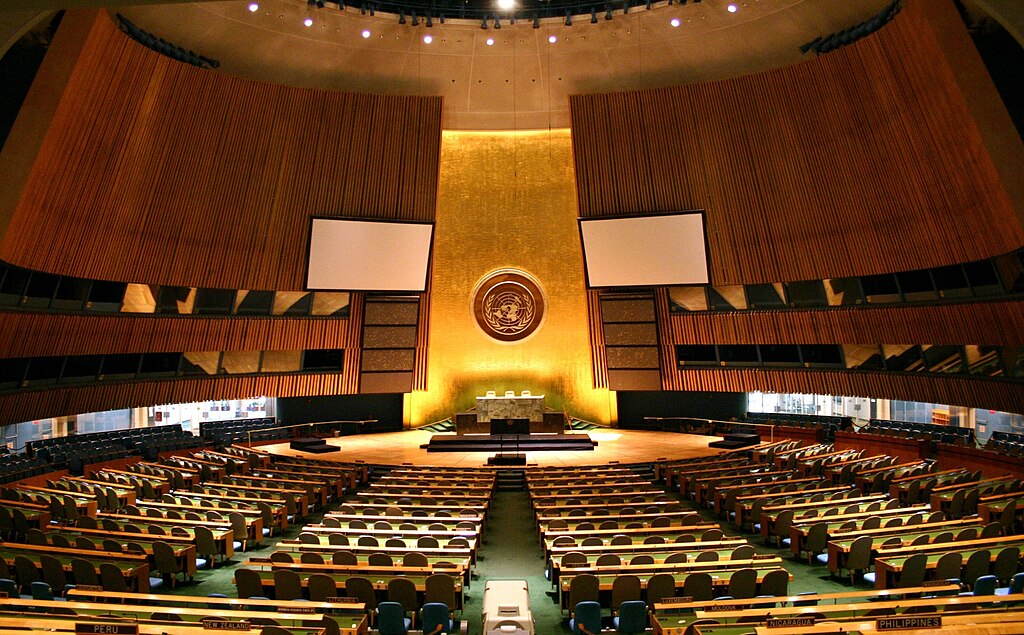
The UN is under direct attack from the Trump administration and Canada must work with others to hold the line
We need commensurate action at the international level, among like-minded nations across the globe, in support of the United Nations and international law. Canada’s recent recognition of the Palestinian state, in the face of adamant U.S. and Israeli opposition, is one bright spot to this end.
But so much more is needed!
It is to these goals that we dedicate our efforts in 2026 and humbly thank all those who continue to support us financially and in so many other ways!
We pledge determined and relentless efforts to continue to identify and promote realistic steps for Canada in defence of, and where possible, in advancement of the core principles on which international cooperation, peace, and security depend.
I wish everyone a wonderful holiday season!
Yours in solidarity and peace,


Photo credit: Creative Commons licence Patrick Gruban (UN General Assembly); Government of Canada (Parliament Hill).
The comments are closed.